ETF comparison tool
NDQ vs IVV
BetaShares NASDAQ 100 ETF vs iShares S&P 500 ETF
ETF comparison
| NDQ | IVV | |
|---|---|---|
| Fund name | BetaShares NASDAQ 100 ETF | iShares S&P 500 ETF |
| Annual fee | -? | -? |
| Dividend frequency | Annual | Quarterly |
| Annualised returns | NDQ | IVV |
| YTD | -8.43% | -6.93% |
| 1 year | 12.16% | 6.88% |
| 3 year | 20.96% | 17.16% |
| 5 year | 15.25% | 14.15% |
| 10 year | 19.86% | 15.21% |
| Dividend yield history | NDQ | IVV |
| 2025 | 0.96% | 1.07% |
| 2024 | 1.85% | 1.26% |
| 2023 | 2.10% | 1.04% |
| 2022 | 3.40% | 1.46% |
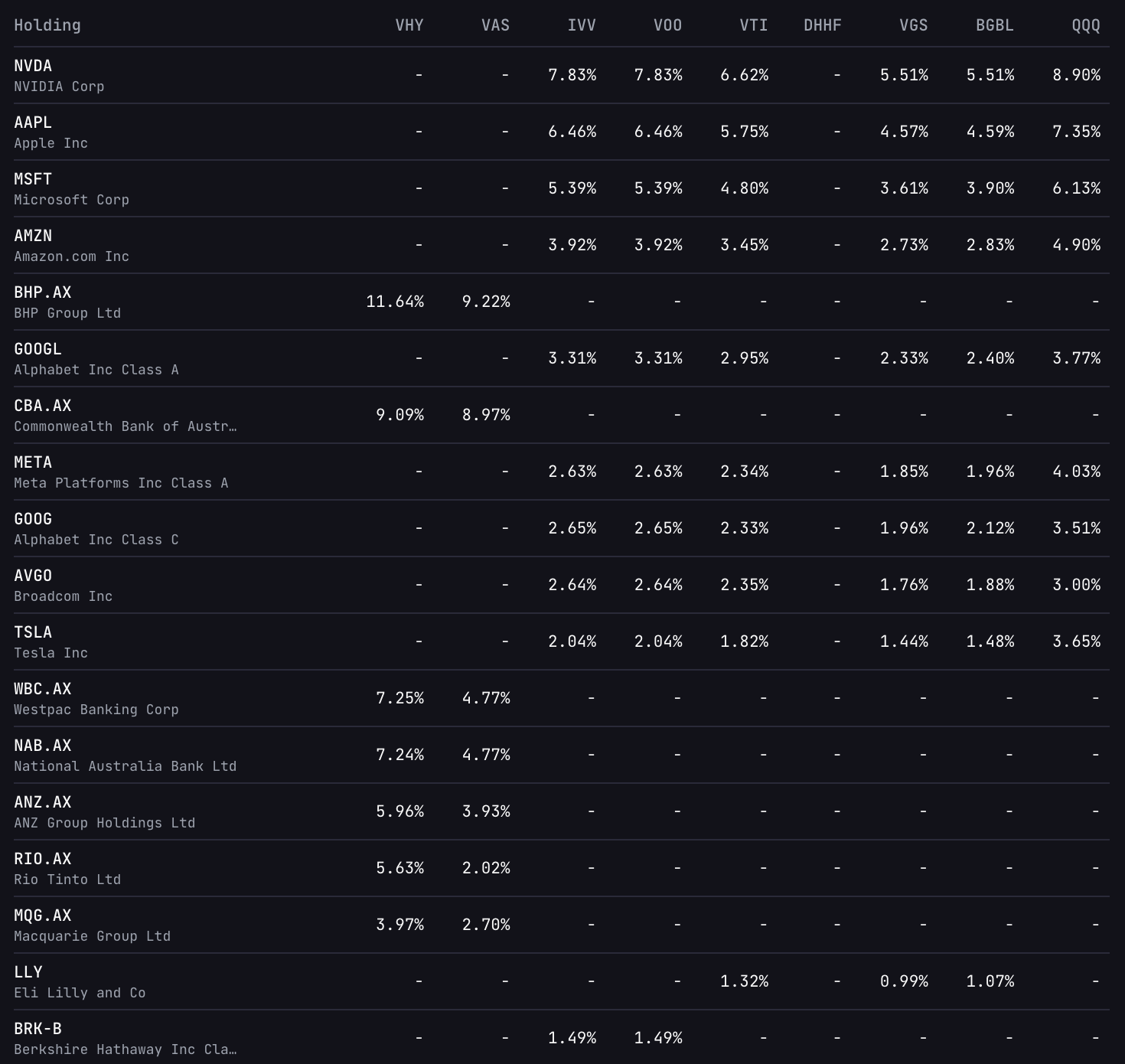
IVV is a fund-of-funds holding IVV (100.0%). Holdings below show the effective underlying exposure after resolving sub-ETF holdings. | ||
| Effective holdings | NDQ | IVV |
| NVDA | 8.69% | 7.56% |
| AAPL | 7.64% | 6.65% |
| MSFT | 5.64% | 4.90% |
| AMZN | 4.59% | 3.63% |
| GOOGL | 3.43% | 2.99% |
| META | 3.46% | 2.23% |
| TSLA | 3.81% | 1.87% |
| AVGO | 3.01% | 2.62% |
| GOOG | 3.20% | 2.39% |
| WMT | 3.44% | - |
| BRK-B | - | 1.57% |
| Sector allocation | NDQ | IVV |
| Technology | 50.4% | 33.2% |
| Communication Services | 16.0% | 10.3% |
| Consumer Cyclical | 12.6% | 10.0% |
| Healthcare | 5.1% | 9.6% |
| Consumer Defensive | 8.6% | 5.4% |
| Financial Services | 0.2% | 12.4% |
| Industrials | 3.5% | 8.4% |
| Energy | 0.7% | 4.2% |
| Utilities | 1.5% | 2.6% |
| Basic Materials | 1.3% | 1.9% |
| Real Estate | 0.1% | 2.0% |
ETF data is based on the most recent available holdings from fund providers. Only the top holdings are compared, so actual overlap may differ. Fund-of-funds holdings are resolved using the top reported holdings of each sub-ETF. Actual exposure may differ. Annualised returns are trailing figures and do not guarantee future performance. This is not financial advice.
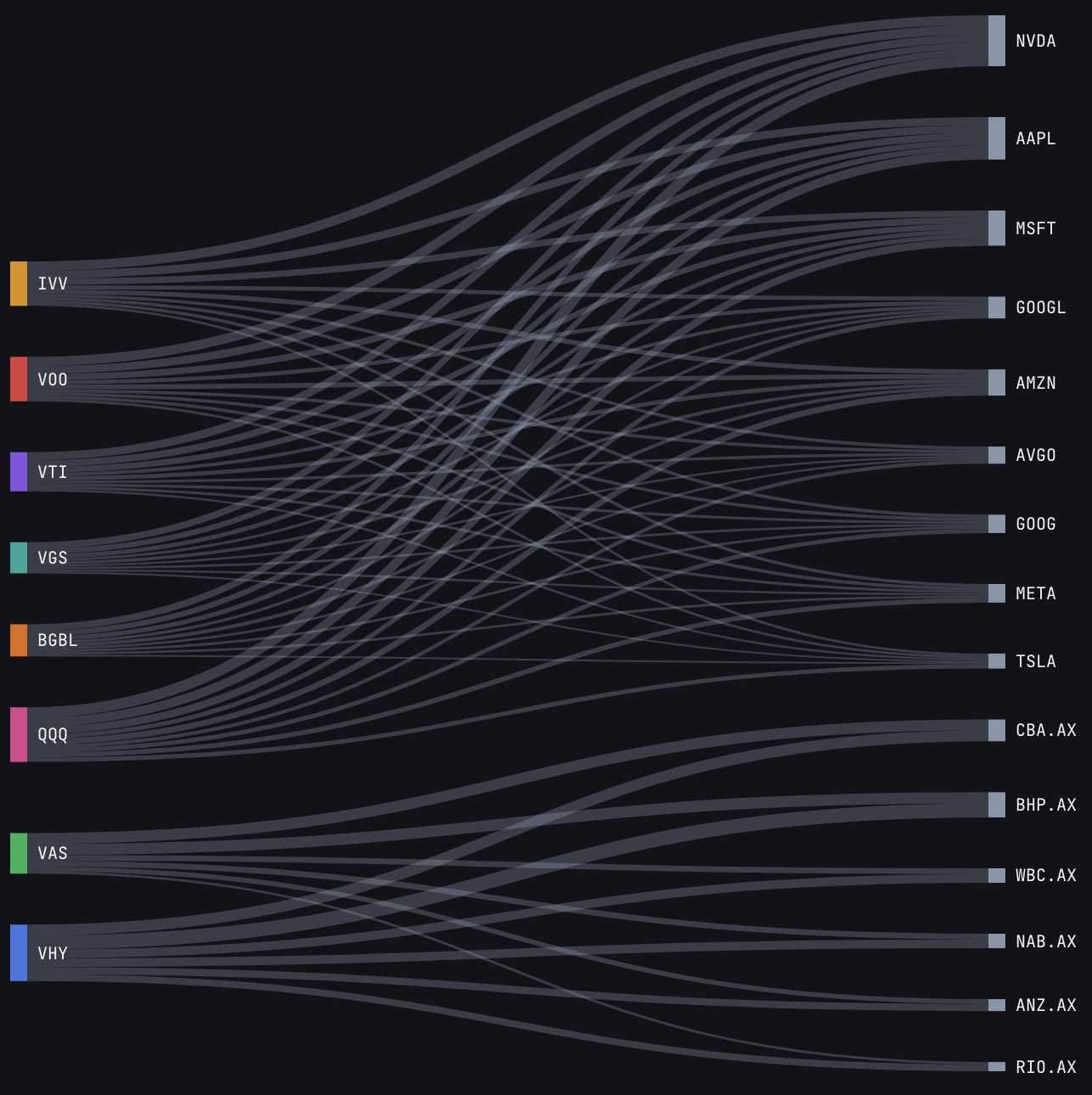
See the overlap across all your ETFs in the same place
Add up to 20 holdings for free and see how your ETFs overlap together, with interactive Sankey diagrams and shared holdings breakdowns. Need more? The Pro plan gives you unlimited holdings, plus tax reports, automatic transaction tracking via email forwarding, and dividend calendars.